The free Medieval Weekend, organised by the Road to Agincourt project, was recently held at Manor Farm and Country Park, Bursledon.
This post continues with a look at the lives of typical villagers re-enacted over the weekend. And I discover what a fletcher was…
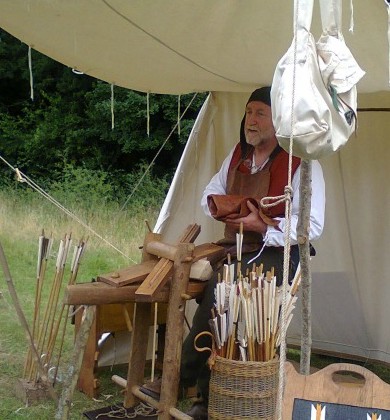
King’s Fletcher (Arrowmaker)
A Fletcher is an arrowmaker.
The King’s Fletcher was a hugely important position. He could enter anybody’s land and requisition trees for the purposes of arrowmaking.
The Fletcher would look for a straight grain (while recognising no tree has perfectly straight grains. It was a question of going for the best available). The more important the fletcher, the more apprentices he had.
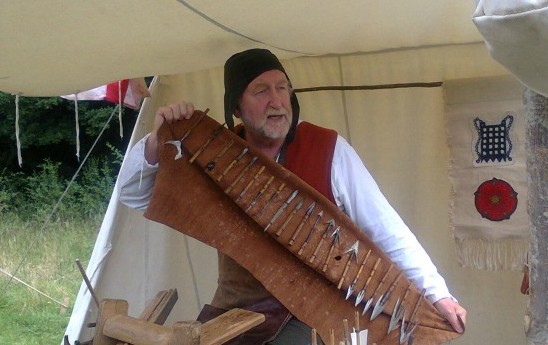
Feathers for the arrows come from goose. Girls from the age of 6 upwards were sent to collect the feathers. It is not clear why but girls were more acceptable to the geese to walk amongst them and collect the feathers than boys.
The fletcher showed off a wide variety of arrow heads and showed a book of photographs of exactly how arrows would kill a boar. These pictures were not for the squeamish but did show just how deadly these things were and the amount of damage they inflicted. (Skin, tissues and so on were often torn by the things and removing the arrow could exacerbate the damage).
The fletcher felt the most damaging weapon was the sharp spike known as the Caltrop that were strewn on the ground to bring down horses. These weapons were deadly, simple and effective. Get one of these things in your foot and you would scream about it…


Interestingly the fletcher then made reference to having to then go to the “witch…er herbalist” whose tent was a little further on from his.
Herbalist
This job hasn’t changed much over the centuries. The main difference has been the increased knowledge of why certain plants can be beneficial in medicine.
Aspirin, for example, comes from willow bark. It was recognised for its qualities in pain relief in the 18th century but in medieval times, feverfew was the plant of choice for easing pain and fever.
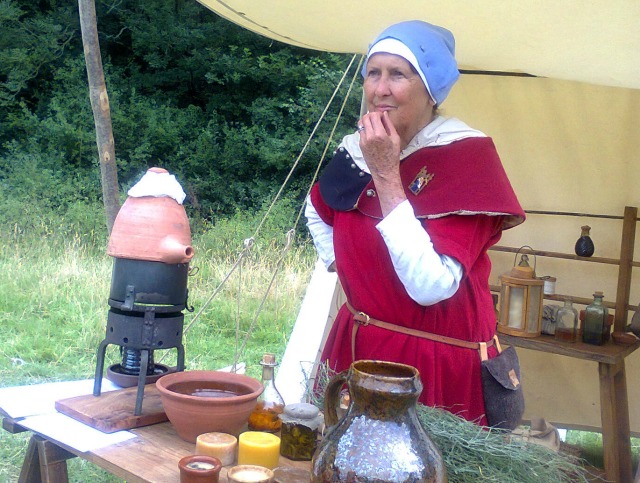
Herbalists could be accused of witchcraft and be at risk of being burned. If things went wrong in a village, it was too easy to blame the herbalist.
Nobody understood the full reason why certain plants worked so accusations of using magic could be easy to make and difficult to disclaim. Herbalists would use a wide variety of locally available plants. Feverfew was readily available and grown.
Basketmaker
Willow is used for basket making. Stripped willow is where the outer layer of the willow is removed and what is left is used to make the basket. This makes the basket look “white”.
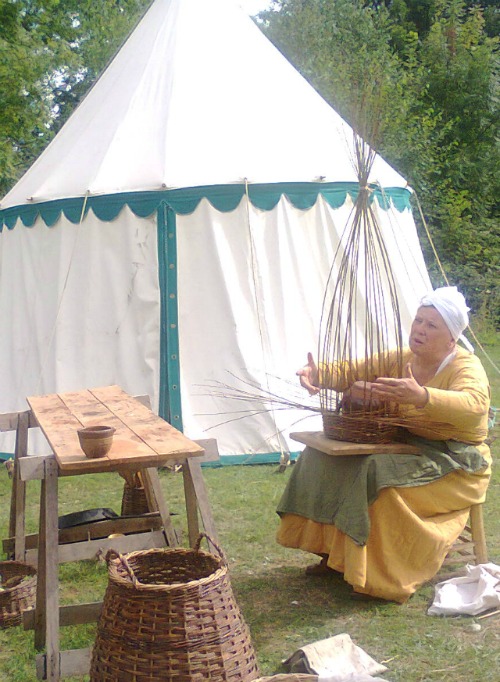
Willow making would take months as, not only would you have to wait for the willow to get to the right point in its development before cutting it, you would then need to wait for those cuttings to “dry” to the correct level before using them.
I watched the basket maker deftly weave the willow “strands” in and out of a frame (also made from willow), tucking the ends in so there were no rough outer edges.
Taverner
The taverner/innkeeper’s job goes back centuries. For one very famous example, see the Gospels of Matthew and Luke!
The importance of hospitality, providing food, drink and shelter to the weary traveller has a very long history. The “tavern” at the weekend was very well decorated with a boar skin at the back and furs on the floor.

The taverner showed examples of early games. There was a wooden cup with a ball on a string, the idea being to get the ball into the cup. There were dice.
One cloth game had numbers in squares embroidered on it. If you scored a number with your dice that matched one of the numbers on the cloth, you would (a) win money, (b) have to pay money to the church or (c) have to pay money to the local lord/king.
The taverner made it clear the “house” always won as the money you didn’t win for yourself went to him! (Not much has changed there!). Options (b) and (c) were meant to be satirical only.
The game was made on cloth so the taverner could roll it up and hide it. The church did not approve of this game as they saw it as gambling (and any money supposedly meant to go to them certainly did not!).
Melford Hys Companie
The biggest hit at the weekend was the Melford Hys Companie who enacted three short plays. My family and I managed to see two of them. The Companie players were hilarious.
I was also introduced, in the second play I watched, to the works of Chaucer, as the players enacted The Miller’s Tale. I did wonder how they were going to do this as it could be said Chaucer was rude! But they managed it and the bedroom farce of this story was very funny.
Let’s just say their version was true to the spirit of the story but if you follow the above link, you will be able to guess at what bits they weren’t able to show to a family audience!
The first play was an enactment of the story of St. George. I loved the dragon costume and the way the actor playing the “head” of the beast literally called for his “legs” to catch him up! I am not convinced that was planned (but it was funny!).

There was also a fire eater put in my picture and and a sword juggler. This was the same guy but these impressive things were not done at the same time!

The Companie gave a flavour of the kind of entertainment that “ordinary” men, women and children would have enjoyed as a very welcome break from the daily drudgery.

Free Companies
Free companies were groups of mercenaries who would band together for support after times of war. They acted independently of government and were known to plunder. (Mind it could be argued that the governments both then and since have done this!).
At the weekend the characters of the soldier, the taverner (usually an ex soldier) and the fletcher were all part of a Free Companie. The Free Companies enabled people to survive as a group.
Conclusion
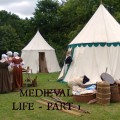
The tent village looked very impressive. The costumes looked good (though how comfortable they were against the skin I would not care to guess at). The craftsmanship of the fletcher carpenter and so on was flawless.
I saw Terry Jones’ marvellous Medieval Lifes series when it was first aired and include the Youtube link. Highly recommend. The accompanying book is also good.
Manor Farm was easy to find but parking is limited so beware. There was lots to see at the weekend. The actors were pleased to speak to people and were clearly very well briefed on their history. The whole event gave a very good overview of what life would have been like during medieval times.
The saying “the past is a different country, they do things differently there” is so true. I would add it is a great place to visit but you wouldn’t want to stay for long…
What’s the biggest “loss” in modern times?
I suppose the biggest “loss” in modern times has been the loss of community which this medieval village re-created brilliantly. But then there is nothing to stop us trying to resurrect that and, yes, maybe in a way magazines like Chandler’s Ford Today can help promote a sense of ourselves as a community.
I do not envy those behind the organisation of this weekend. The amount of work put in must have been colossal. I am glad the Road to Agincourt website reports over 2000 people visited the Medieval Weekend. It was a success. While this weekend was for a specific commemoration, maybe it shows there is an audience for visits to the past like this.
For more on this weekend, see the Road to Agincourt website, which gives highlights.
Note: All images by Allison Symes
Related Posts:-
Read interviews with Chandler’s Ford writer Allison Symes: Part 1 and Part 2.
Read blog posts by Allison Symes published on Chandler’s Ford Today.
Never miss out on another blog post. Subscribe here:





[…] post for tonight is part 2 of my overall review of the recently held Medival Weekend, organised by the Road to Agincourt Project. The weekend was a lot of fun but I am so glad I live in […]