Image Credit: Images created in Book Brush using Pixabay photos.
Hooks are wonderful. They lure you into reading until you reach The End. The nice thing is this applies just as much to non-fiction as it does to fiction. Why?
Because all forms of writing have to offer something of value to the reader to get them to read it. For non-fiction, it will be information of use to the reader (and I hope most of my CFT posts do that, it’s my aim). For fiction, that something of value will be an entertaining read, regardless of the genre being read.
The best hooks of all are the kind which make you look up from a book or a story, realising you’ve read far more than you intended to at that session. You weren’t even aware of being drawn in. I adore being hooked that way. It is the definition of a riveting read and a sign the author has done their job well.
Questions as Hooks
I often use questions in this way. Sometimes I use them as the title of my story. That flags up to a potential reader immediately the story has to answer the question. You do have to deliver on the premise you set out. A reader won’t return to a writer who fails to deliver on an interesting premise. (I know I wouldn’t). So I have a story structure in place immediately here.
But for a reader, if it is a question that intrigues them, there is only one way to find out how the writer answers it and that is to read the story. Job done. (The real hook here is for them to like what you did and go on to read more of what you do).
I also use questions as a theme for my stories. I sometimes use them as themes for my blogging. I don’t necessarily have to spell out the question directly though what it is becomes apparent from context as people read on. The idea here is the theme intrigues them enough to want to find out what I did with it. Again there is only one way they can find out and that is to read the piece.
Characters as Hooks
This is a great favourite of mine. It works best in fiction, of course. It’s not impossible to do it for non-fiction though. If you create an interesting narrative voice for your non-fiction pieces, your narrator/you can act like a character here. The something of value to your readers here is getting to hear your voice and see what you do with the latest topic but they are reading you as a character here.
For fiction, I create a character who intrigues me. I’ve got to find out what happens to them. I take the view if I feel that way about them, so will others. You are your own first reader. If you’re not intrigued enough to find out what happens next, why should anyone else be? This is something I always keep in mind because it reminds me to think about what the reader will get out of what I am offering them to read. And they really should get something of value out of it.
I often use random question generators here to help me work out what my character is made of and the questions which are thrown up, such as what do you value the most and why, I answer in the voice of my characters. If my character values being a great getaway driver the most, you’ve got to find out why and how they discovered this, yes? There’s a story outline right there.
I’ve found knowing my character really well helps me to hear their voice and thus get that down on the page. I need to know their major traits and what can lead from that. Also what kind of trouble those traits can lead them into. Bear in mind a honest character can drop themselves and others right in it. Potential hooks right there. I want to find out what trouble this honest characters gets into and if they can get out of it.
Situations as Hooks
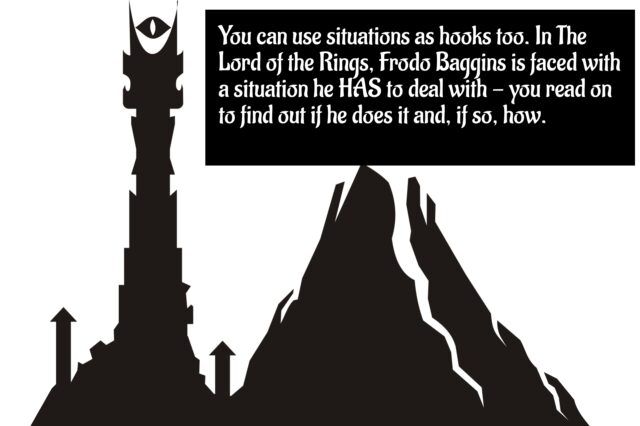
This is another classic. Set up an intriguing situation. The reader has to find out how your characters handle it. Think The Lord of the Rings here. Frodo Baggins has a task he absolutely has to do at great personal risk. How is he going to do it? How does his strange world (strange in terms of it being nothing like we know) impact on what he has got to do?
Also with this kind of hook, the story has to supply the answer. The situation has to be overcome or not. The latter is more unusual. A writer I think would need to show something was not overcome because dot dot dot (and it needs to be an exceptionally good reason) but also show the character limited its impact. That can be a solution of a kind. It’s not the one I’d be happy with. I want something definitely resolved (I like to see dodgy rings thrown into volcanoes so I know evil is overcome!) but personal taste comes into this too.

Playing Fair
This is crucial. Agatha Christie was moaned at for the way she ended The Murder of Roger Ackroyd. It’s a fabulous story, do check it out if you haven’t read it. It was felt she hadn’t played fair with her readers. Truth is, she did. The clues were there. I think it was a case many people hadn’t spotted them on the first read through. There are certain books where you do need to re-read it to spot those clues and this is one of those. It justifies re-reading (as does all of her canon).
But the bottom line is if you use a hook to lure in your reader, you have got to ensure the bait for them was well worth their time. You do have to deliver. For my twist in the tale flash pieces, I often know the ending first and then work out logical ways of getting to that point. The huge advantage of doing that is it means I can plant clues in the right places and I know from the start I am going to deliver on what I am promising my readers here. I’ve already figured out how the story has to end.
Can There Be Too Many Hooks?
Every story, regardless of length or genre, has to entice the reader into reading it so I think every story therefore has to have some kind of hook. It’s what the blurb on the back is for – to entice the reader to go and buy that book. Some hooks are more subtle than others.
For a twist tale, I like to have one strong twist and I leave it there. Crime novelists will need more to cover the length of their book. But whatever twists you have, and however many, they have to deliver on the premise and be appropriate for the kind of story you are telling.
Don’t annoy the reader. You only pull that stunt once. An ideal twist is one the reader didn’t see coming but they enjoyed it enough to go back through the book to spot the clues they missed first time around. I love doing this.
Conclusion
No matter what the hook, the characters and the story have to be strong enough to “carry” it. A weak character will let a good story down. A fantastic hook won’t work if the plot falls apart. So all aspects of the story have to be in place. You have to convince the reader that in this setting this event could have happened as I’ve told it. You are asking them to willingly suspend their disbelief to enjoy your fiction.
So make the hooks good, make the characters great, and the plot one where they have to find out what happens.
That is a good story.
Related Posts:-
Read interviews with Chandler’s Ford writer Allison Symes: Part 1 and Part 2.
Read blog posts by Allison Symes published on Chandler’s Ford Today.
Never miss out on another blog post. Subscribe here:


Leave a Reply