Image Credits: Images created in Book Brush using Pixabay images
You take in what makes a story work subconsciously. Even as a child, when I read the classic fairytales, I knew on the third time of something occurring, there would be a different result leading to the happy ever after ending. I had no idea that was the Rule of Three in action. I just knew if this didn’t happen, there was something wrong with the story. I also knew early on I had to want to find out what happened to the characters so there had to be something interesting about them to grab my attention (and just as importantly keep my attention going).

The Role of Dialogue and Description
When you read dialogue in a story, you want to feel as if you’re following an interesting conversation. Description needs to give you enough to picture the scene without sending you to sleep. I do think since the invention of the TV and film age, writers have an advantage. We don’t have to literally describe everything as say Charles Dickens did because he knew so many of his readers would never visit London so he had to give them something they could picture when he set his stories there.
But we also have to be aware of how language and its usage changes over time so need to ensure our characters’ speech is not just appropriate for them and their genre, but also the time in which the story is set. I can’t have contemporary characters speaking in Olde English (unless that is somehow part of the story – e.g. they’re actors performing Shakespeare – but the reason would have to be good).
The more you read, the more you take in. By reading widely across genres, you will spot what is apt for one genre isn’t going to be for another. The kind of dialogue you find in a romance story is highly unlikely to be written in the same way for a horror tale. Well, I would hope not anyway!
What You Take In From Stories
Of course, you get used to the idea of having a proper beginning, middle and end too. That is based on the Three Act Structure for plays. There has to be a set up, a conflict, and the resolution. The format works and has stood and will continue to stand the test of time.
Where a story has a theme, the whole thing will work if it delivers on that theme. So if the theme is justice (which can cross other genres, not just crime), the reader will expect to see justice dished out in some way.
Understanding how a story works will help as you write your own tales. It can also give you understanding of the market in which you wish to write. You will read, by studying what is already out there, what is expected. You can use that to work out how your own story would fit in and that in turn will help when it comes to pitching to publishers and/or agents.
You expect to see then an interesting character involved in events which become more “dramatic” as the story goes on (and this is especially true for thrillers) before the tale is resolved. And there must be a resolution, even if it isn’t a happy one.
Even Non-Fiction Can Tell A Story
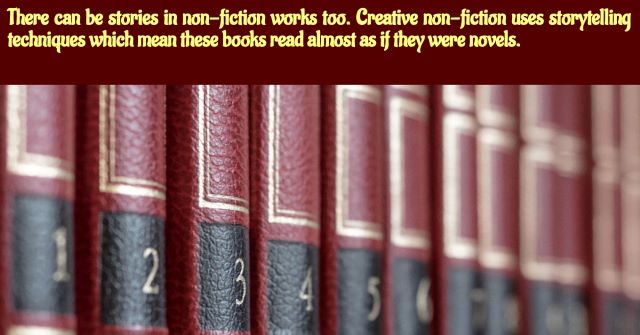
There can be stories in non-fiction works too, funnily enough. Creative non-fiction uses storytelling techniques to get across information in ways which mean these books read almost as if they were novels. What is needed here is a strong narrative voice, just as for fiction. Again, we know any story works if it has this. You don’t have to like the narrative voice/character but you do need to know whose story it is. No head hopping here.
Understanding the Characters
In fiction, readers need to be able to see where the character is coming from and what drives them to be as they are/do as they are. I can think of a few of my own characters whom I wouldn’t like at all if I could meet them for real. I did have to get inside their heads to understand why they are the way they are. Many fiction writers will tell you that sometimes getting into a character’s head so you can write their stories up properly can be an unsettling experience.
A story also works when it follow a natural progression. We expect it to start at Point A, go through Point B, and reach its destination at Point C.
Stories work when the theme emerges as they go on. Going back to the justice theme, I will need to see why this is the chosen theme and then see how it is “acted out” by the characters.
The Acid Test for Whether A Story Works
But above all, the stories work when they grip you enough to keep reading on. For me, this has always been about whether the character interests me enough. If they do, I will follow their adventures.
I had no problems reading The Lord of the Rings due to that. I have switched off much shorter works when the character did not keep my interest. There is some good to come out of that though because I can work out what it was about the character which failed to keep my interest going and then try and avoid doing that with my own creations.
I generally read for entertainment. For non-fiction “stories”, I read to be informed and entertained. So if a book or story doesn’t deliver on those things, it will fail for me.
But, of course, different readers have varying ideas of what would entertain them. I love reading. Yes, I could read the back of a cornflake packet if there was nothing else to read (not that I think this will ever be a problem for me. You should see my To Be Read pile, the one on my Kindle is also of a good size!). But this is exactly why I need to know the book I pick up to read next is likely to entertain me. Life is too short to waste on “dud” books. I have, thankfully, only ever come across the odd few which did nothing for me at all.
I also like to see how a character develops as the story goes on. Story is all about change. A character shouldn’t be the same as they were at the beginning of the tale, Their experiences in the story are bound to change them in some way, for good or for ill. But I need to see that development there.
And I would say the development of Sam Vimes from Terry Pratchett’s fantastic Discworld series is, for me, one of the best character arcs ever written.
The Sam Vimes in Guards! Guards! changes so much by the time you come across him in his final appearance in Raising Steam. The drunk copper becomes a hero. What I do love about Vimes is you also see how his personal life develops too and how that changes him. Fascinating stuff and adds so much to the tales. Do check them out.
Conclusion
What we all want then is a good read, a “riveting good yarn”, and it is my belief the characters are the key to making this happen for a story. We read stories to find out what happens but the crucial bit is here is we are finding out what happens to the people/other beings of choice in those tales.
And yes fiction can be a good mirror to what is happening in the real world. It can also give us some much needed escapism from that real world too. We need stories to take us away from it all at times, I think.
Happy reading!
Related Posts:-
Read interviews with Chandler’s Ford writer Allison Symes: Part 1 and Part 2.
Read blog posts by Allison Symes published on Chandler’s Ford Today.
Never miss out on another blog post. Subscribe here:






Leave a Reply