Image Credit: Images created in Book Brush using Pixabay photos. One image taken by me, Allison Symes, at The Hilt Book Fair.
History is full of stories, which is one reason I love it. Of course, history is said to be written by the winners. There is truth in that but every so often someone will come along and come up with alternatives to the “orthodox” version. Josephine Tey did this in fiction regarding Richard III with her marvellous The Daughter of Time, which The Richard III Society credits as being a major reason for many people joining them.

Untold History
There is also untold history. Books, fictional and otherwise, so often focus on the major characters in history. This is understandable. They are the “big draws”. But I sometimes wonder about things such as the tales servants of the period could tell if they were able to do so. Naturally this is a rich seam for historical fiction writers to explore further.
A good historical fiction novel (or collection) will encourage a reader to read more on the time period they’ve become interested in. The Daughter of Time led me to read Sharon Penman’s The Sunne in Splendour, which is a huge novel (and can probably rival The Lord of the Rings for word count!). I’ve also gone on to read Annette Carson’s The Maligned King and Philippa Langley’s The Princes in the Tower on the non-fiction front.
Historical Flash Fiction
I’ve sometimes written historical flash fiction. Even with a maximum word count of 1000 words, you can convey something of the period in which you are writing. The focus here is on one telling detail (no word count room for more) but pick the right one and you can conjure up much more of that world for your reader.
I’ve sometimes written a flash tale from the viewpoint of a known historical character. The one conceit I have allowed myself here is to get my characters to speak in modern English since old English is hard to read. What I stick to here like the proverbial glue is coming up with dialogue and sentiments it is likely my character could have had. Plausible believability is the name of the game here!
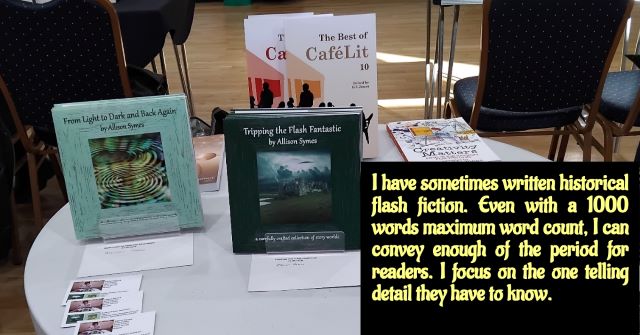
I’ve also sometimes written a slice of life flash tale where my character shares something of their life with the reader. These work best when kept short, I find, so flash is ideal here. What I do is get my character to reflect on historical events which had an impact on their fictional life.
In my They Don’t Understand (From Light to Back and Back Again), my character looks back at how World War Two impacted both himself and his wife, who were children at the time. He goes on to talk about the introduction of drink driving limits later too.
“Dropping” History into a Story
It is possible then to “drop” history into a story with the right telling details, including social history. Technology can have an impact here too.
I was a huge fan of The Famous Five by Enid Blyton when I was growing up. Problem is stories like that have to be set back in time. Why? Because these days the Five would simply use their mobile phones to ring for assistance – story killed off right there. You can get around things like that by setting your characters in a poor reception area for mobile signals or go back in time before the advent of these things. So history can play a part with an author deciding when is the best time for their story to take place.
Names can be used to indicate likely historical periods in which the story is set too. Classic names (Charles, Edward, James etc) don’t tend to “date” so a writer would need something else to indicate their story’s time period. However, names like mine are linked to certain periods of time. I’ve yet to meet an Alison/Allison/Alyson who is not around my own age range!
Focus on What Readers Need to Know
The crucial thing with any historical story is to ensure whatever details you use, you are spot on with them. Readers do and will pick up and point out errors (especially on social media). Another temptation to avoid is having carried out all of that lovely research, which you so enjoyed doing to get your details right of course, is to put every single bit of it into your story! Focus on what your readers need to know.
With any fictional writing, the author needs to know more than the reader does. It helps you to get your outline right (if you use one as I do). It also means you know when you write about a certain time period, you know the details you are using are correct. But if, for example, you were writing a tale set in the First Elizabethan era, you might want to refer to the ruff as part of the clothing your character wears. It helps set the period. You may not want to mention every single thing they were wearing, even if you have found out what these would be.
Historical writing, fictional and otherwise, can bring past eras back to life for people, can show aspects they hadn’t known (the Ben Macintyre series of books regarding World War Two are an excellent example of this I am more than happy to recommend), and can demonstrate how language, clothing, and traditions change over the centuries (no more ruffs to wear for a start!).
When I read historical fiction, as well as enjoying the tales directly, I am looking out for the “background” characters and their role in the tale. A monarch would have had their servants. What role do they play in this story? That could be crucial. How many over the centuries have acted as messengers in their time, with or without the boss’s approval?
Conclusion
I love history. I love reading and writing stories. To me it makes sense to have historical fiction as a category. The best works here can encourage reading the non-fiction department here. That has happened for me.
I suppose also because we all have our own personal and family histories, history as a topic will always resonate. My slice of life tale mentioned above was inspired by the thoughts of what my late parents would have experienced when they were children during World War Two.
Writers do bring what they know into a story (and research more). History has meaning. Stories have meaning. Stories can bring history to life for people and I think that matters.

Related Posts:-
Author Interview: Val Penny and Historical Short Stories – The Ring
Read interviews with Chandler’s Ford writer Allison Symes: Part 1 and Part 2.
Read blog posts by Allison Symes published on Chandler’s Ford Today.
Never miss out on another blog post. Subscribe here:



Leave a Reply