Image Credits:-
Photos from The Dorset Museum, Dorchester were taken by me, Allison Symes, as were pictures from my garden and any screenshots. Other images were created in Book Brush using either my photos or those from Pixabay. AI images avoided.
I recently revisited The Dorset Museum in lovely Dorchester with editing colleagues from The Chartered Institute of Editing and Proofreading. We were visiting a Thomas Hardy exhibition and it was fascinating.
One thing which struck us all was that in Hardy’s lifetime (1840 to 1928), he would have seen so much change from the coming of the railways to the Boer Wars to new monarchs, Edward VII and then George V, to World War One and the period directly after that. There would have been so much in the way of scientific developments and electricity coming into people’s homes etc.
Mind you, I was delighted to see his writing desks. They were magnificent as was the most beautiful inkstand I’ve ever seen. I had no idea the Order of Merit, which he was awarded, was so lovely either.
Now I must admit I’ve not read any of Hardy’s work (though I did get to do so during the visit. They have various of his notebooks and I enjoyed looking at those). This thought led me to wonder how do we discover the classical authors whom most people have heard of but have yet to discover for ourselves.
I suspect this exhibition will be the way in to reading Hardy for me. Certainly it has provoked my curiosity to change my “duck” here. Indeed, I guess this is part of the purpose of the exhibition. (It was a joy just to be back at the museum incidentally. It is a fascinating place and I still haven’t seen all of it).
So other than reading the books directly (which I’d like to see as the end result if you discover the author another way), what ways could there be in discovering classical authors for yourself?
Exhibitions
I was last at The Dorset Museum to visit the Jane Austen exhibition which was also great. Going to that one with some knowledge of the author and her works was useful but in going to the Thomas Hardy one, where that wasn’t the case for me, was also enlightening.
I had no idea, for example, Hardy was also excellent in drawing and painting and drew up the architectural plans for his house. Exhibitions like these can provoke curiosity to know more about the author then and, from there, to read what they wrote. His handwriting was exquisite too.

TV and Film Adaptations
My late mother already had the works of Dickens at home but that wasn’t how I read him for myself. My way in was by watching the film version of Oliver Twist one weekend afternoon on BBC2 where Sir Alec Guinness played Fagin and Oliver Reed played Bill Sikes. Both actors were seriously scary. I wept for Nancy!
After I’d watched the film, I had to read the book to see if it was as scary as they’d portrayed. Even then I knew film could and still does embellish things (often correctly for dramatic purposes to be fair) but not here. The adaptation was faithful to the original book. I then read more of Dickens (and yes, I wish he’d behaved better towards his wife).
The other great film adaptation of Dickens’ work has to be The Muppet Christmas Carol. It is a tradition in my household to watch this in the run up to Christmas. Sir Michael Caine is superb as Scrooge and plays the character “straight” and the adaptation is so close to the original.
It can’t be an exact 100% adaptation though because there was the addition of another Marley to the story (so The Muppets could get the gag in about Jacob and Robert Marley – think about the abbreviation for Robert here!). Mind you, the film does end with the recommendation you read the book – quite right too! The Muppet songs were appropriate for this film too.
Set Books For English at School
This is where I discovered how great Jane Austen is as my wonderful English teacher, Miss Mackenzie, introduced us all to Pride and Prejudice. One problem in having set books is it can take away the joy of reading the things because you’re focusing on meaning etc but this wasn’t the case for me here.
What the studying of this book did for me was introduce me to the idea irony in fiction was a thing (and Miss Austen wonderful at that too). I went on to read the rest of Austen’s work as a result of all of this though I will confess to disliking Mansfield Park as I find the “heroine” far too wishy-washy for my tastes. I much prefer Elizabeth Bennet and Anne Eliot.
Miss Mackenzie did me another favour here too. Our next set book was The Day of the Triffids by John Wyndham and I admit my first thought when this was announced was I am going to hate this, it’s science fiction.
I didn’t hate it, far from it. What I learned here was it is fine to like more than one kind of book and this one kicked off an interest in science fiction. I read more fantasy, to be honest, especially Terry Pratchett, but I still haven’t had a greater contrast in books to read than Pride and Prejudice immediately followed by The Day of the Triffids! And I’m open to science fiction!
Radio Dramas
Many great stories are adapted for radio. Some of Terry Pratchett’s works were and the collection of those made an excellent present to give to the other half some years ago. The huge advantage of radio is you have to listen, I think you take in more as a result, and the characters and dialogue must stand out for the adaptation to work at all. Naturally listening to these can be another fantastic way to discover authors new to you or more works by that author.
Plays
Now thanks to visiting The Chameleon Theatre Company productions and enjoying those put on by National Theatre Live, I’ve discovered all manner of stories, including those written by the Bard of Avon. My late mother would have wondered why it took me so long to discover Shakespeare but, with the exception of his sonnets, I believe he is meant to be watched rather than read. But I still discovered his stories when I watched them!
The same goes for the other plays I’ve had the privilege to see. Stories aren’t confined by format. There is a story format to suit all (and many of us like several of them) but there is something about watching and/or listening to a play which takes you back to the oral tradition of storytelling, which I also love.
Libraries
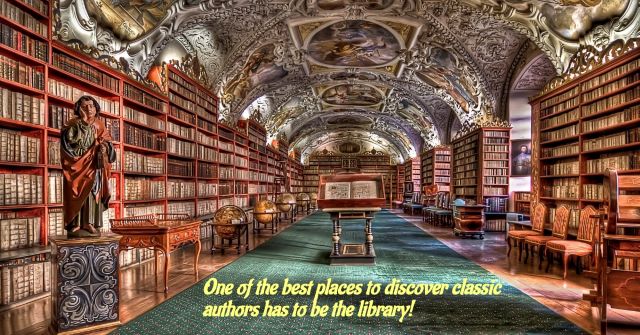
Name a better place to discover authors new to you, classic ones or contemporary! Indeed, many a borrowing from a library has led to a life long love of a particular author’s work. That kind of thing tends to lead to visits to bookshops to get your own copies! Guess how I know…
Conclusion
There are so many ways to discover authors, classic ones and contemporary, and if those ways encourage reading of the original books so much the better as far as I’m concerned.
Audio books are a great alternative for those who might be put off by the thought of reading “big books”. They’re also great for long journeys and/or where reception (radio and otherwise) can be “iffy”. What matters, I think, overall, is the taking in of the stories.
And the good news?
There is at least one way out there to suit everyone.
Happy reading and discovering new authors, however you do this, contemporary and/or classic ones.
P.S. Don’t usually do one of these but after my trip to The Dorset Museum, I had the nice surprise that evening of a visitor to the garden. Isn’t she lovely?
Related Posts:-
Read interviews with Chandler’s Ford writer Allison Symes: Part 1 and Part 2.
Read blog posts by Allison Symes published on Chandler’s Ford Today.
Never miss out on another blog post. Subscribe here:



Dear Folks,
I have just read The Long Road Home by Wendy Green and would like to know a little more about how she is doing. I am 80, and I think she may well be in her 90’s.
Chris Bradwell
Methodist Local Preacher
Many thanks, Chris, for your comment.
Can anyone help here?