May is a charming name for a lovely month, I think. It was also the name of my maternal grandmother (May Elizabeth).

May is a charming name for a lovely month, I think. It was also the name of my maternal grandmother (May Elizabeth).
On April 16th 1967, Gran writes of a kind gesture, telling us that:
…Mrs Dowson, who taught Barry and Jane at Sherborne House School, came to take Mother and me for a drive, mainly so that Mother could see Primroses at their best. We went through Hursley and Farley Mount… and on towards Sparsholt…
Dad adds a little bit of background:
“Sherborne House School in Lakewood Road, was opened in 1933, shortly before I started there. The Headmistress was Mrs [Eva] Wise. Her two daughters, known as “Miss Dorothy” and “Miss Wise” [Nancy] made up the rest of the staff. “Miss Wise” married soon after I left, and became Mrs Dowson”.
And:
In 2003 the school celebrated its 70th anniversary. Seventy-three-year-old Barry was invited to the gathering at the school and there he found “Miss Dorothy”, over one hundred years of age but still remembering “Barry Goater, the boy who was late for school one morning because he had found a Pine Hawk-moth”.
Gran, Greaty and Mrs Dowson drive on, to Leckford and Stockbridge, and then, Gran continues, “We turned off the main road and came to a wide grassy verge along a lane, which was carpeted with Primroses, a glorious sight. Mrs Dowson picked a posy for Mother”.

[Read more…] about Forty Years in Chandler’s Ford – a Journal (Part 125)
Lakewood Road decided to have a socially separated street party yesterday for VE75. I replied to the invitation and said I was at an original VE day party. Several people expressed an interest in the comments so I thought Chandler’s Ford Today might like to see them. As it turns out, I am not the only one who attended an original party.
[Read more…] about VE Day 75 in Chandler’s Ford – Memories of the Original VE Day
It is Christmas Eve, 1966. The Brenan family arrives at The Ridge for the festivities and, Julian and I, the two older grandchildren, Gran writes, “…came, bringing their little half-sister, Fiona, and Julian took them, Katherine and Fiona, to the Lake before lunch”.
Christmas Day at The Ridge passes as usual, with presents passed out round the tree after breakfast, preparation and enjoyment of the dinner (no doubt with the traditional Woodpecker cider), and enjoyment of the grandchildren’s antics. Tradition, though, is broken uncomfortably for the first time since Gran began her journal, twenty years earlier, Gran writing of the day: “…I was sorry not to be able to start it by going to Church. With an invalid and the family to look after I just could not get away”.

[Read more…] about Forty Years in Chandler’s Ford – a Journal (Part 124)
Barry is in Chandler’s Ford on August 24th 1966 and that evening he and Gran, “…dashed to Winchester to see Yellow Henbane Hyoscyamus luteus, a rare plant from Czecho-Slovakia, which had appeared on a bank near the new Police Headquarters”. The next day, Gran, very much enjoying Barry’s company, enthuses:
Barry and I went, on bicycles, to Farley Mount this morning, stopping first at Otterbourne Hill for him to see the Hairy Bird’s-foot-trefoil which I found last month and which was new to him.
And:
The post today brought me a first-day cover from Gilbert Whitley in Japan, with stamps issued for the Science Congress at which he is reading a paper. A most interesting cover to have, and of special significance when one has a friend intimately connected with the Congress.
[Read more…] about Forty Years in Chandler’s Ford – a Journal (Part 123)
April 9th 1966:
This afternoon, in sunshine, Brother and I went out together, going by quiet ways to the New Forest… We passed the Sounding Arch, across which Florence Nightingale used to pass from her home, Embley Park, to the Church at East Wellow (in which churchyard she is buried) but which was recently struck by a lorry which was too high for it, and it has now had its top removed, so there is no longer a passage from Embley to the Church.
They drive on the Millersford Bottom, where they leave the car and walk:
…joined by a very friendly Golden Retriever, which stayed with us until we returned to the car, sitting down and patiently waiting every time we stopped to watch birds or investigate anything.
April 14th:
A horrible shock on awakening to a white world this morning! Yes, indeed, snow had fallen in the early hours and lay to a depth of about two inches. It was 1950 that I last recorded snow in April and I remember a heavy fall in 1908 when I was living in Bassett.
[Read more…] about Forty Years in Chandler’s Ford – a Journal (Part 122)
On September 11th 1965 Gran writes:
This afternoon Dr Dony and his wife called in on their way to Milford-on-Sea, to arrange a day’s botanizing with me. We have fixed for next Thursday. This evening I went to see Mrs Freestone, still in Winchester Hospital. She is still very confused, but she knew me and was glad to see me.
At the end of the next day she writes, having decided against going to Church:
I was going to Church this evening but was put off by the knowledge that the Rector is away and it was to be modern music tonight. I do not like modern music at all and am sure I should find it offensive in Church – it is the peace and serenity that draws me there, and modern music jangles the nerves with its discordant noise. Perhaps I am prejudiced and should have gone with an open mind but I am too old to accept such changes in my place of worship.
[Read more…] about Forty Years in Chandler’s Ford – a Journal (Part 121)
My [silver] discs for Andrew and Geoffrey arrived from Canada this morning, so, after a hurried lunch, I took my Grandmother’s bracelet to Parkhouses to have them put on, and to have a safety chain added.
On the same day, January 28th 1965, Gran delivers a very expensive arrangement of flowers to Lady Sopwith, aboard the Windsor Castle. It is made up entirely of pale pink Cymbidiums, Lilies-of-the Valley and Freesias, and Gran is pleased with the Lady’s positive response to their arrival, different, she says, from the often blasé acceptance from many passengers. Lady Sopwith was very keen on field sports and a skilled user of the shotgun. Gran would not have approved!
“I did only the most necessary chores this morning”, she writes on January 30th:
…and then watched on Television, the State Funeral of Sir Winston Churchill which was most beautifully and reverently presented. The Queen herself honoured the great man by heading the Royal Family representatives in the Abbey and it was a very notable gathering of Kings, Queens, Princes, Presidents and Prime Ministers ever seen at the funeral of a Commoner. It was all very moving. This afternoon I did some knitting and then fell asleep!

October 4th 1964: “A quiet afternoon writing more letters”, Gran tells us, and she continues:
…this evening I went to Church, primarily to give thanks for Geoffrey’s safe arrival and Jane Elizabeth’s well-being, but it proved to be a most uplifting and inspiring service, conducted by a visiting clergyman, a Welshman, whose name I unfortunately do not know. His sermon was based on our interdependence one upon the other and our Brotherhood in God the Father, and he spoke with the utmost sincerity and forthrightness. I shall long remember this evening.

The Chameleon Theatre Group have been posting a series of small interviews. They and I thought it a good idea to compile these in some articles for CFT. Hope you enjoy! These will hopefully be spread out over a few weeks between each one. Many thanks as ever to The Chameleons for the photos.
Oh and don’t forget that when you go to one of their excellent productions and take part in things like the raffle, proceeds go to a nominated charity. So have a great night out and support a good cause at the same time. Now that’s the kind of multitasking I’ve always got time for!
And now over to The Chameleons for Part 1 in what we hope will be an enjoyable series.

Gran does love a wedding, and on June 20th 1964 she attends that of the eldest son of her great friend, Mary Harding. She describes the event in detail, as is her wont, including the flowers decorating the church, and also the clothes worn by the bride and her attendants thus:
This afternoon I went to Timothy Harding’s Wedding to Daphne Beare. It was at Chandler’s Ford St Boniface Church, and the reception at Otterbourne Hall. The bride wore a long lace gown, full-length veil and carried a small bouquet of pink rosebuds and Stephanotis. She was attended by five charming child bridesmaids, the four older ones in two shades of blue, long dresses of spotted nylon, and the little one in white with blue piping at the waist.
Jill Harding [Timothy’s sister] sang a solo, “Guide us, Lord”, as the bride arrived. The service was choral… Mary looked delightful in a black and pink figured dress and coat, and a black hat with shaded crimson and red roses across the front. The sun shone, happily, but it really was cold.
Two days later Gran, with Peg Eagle and her recently ill son, “pay their respects” to the Wild Gladioli growing in the New Forest. She writes:
This afternoon I went out with Peg – the first time since John came out of hospital. I met her at Bassett and we took John with us, though when we arrived at Beaulieu Road, he remained in the car and did not walk with us.

They are successful with the Gladiolus, and Gran writes later, early in July after another visit there with John Guningham (now spelled without a double “n”), that:
…it really is a most flourishing colony. We saw dozens without disturbing the protective bracken, and there must have been literally hundreds under this cover in the wide area so colonised.

[Read more…] about Forty Years in Chandler’s Ford – a Journal (Part 118)
What are your favourite landmarks and why have you chosen them?

Being a Grandmother is a great joy to Joan Goater. On March 13th 1964 she receives some welcome mail from overseas, and reports:
Today’s post brought my Grandmother’s bracelet from Jill Brewster in Canada, silver discs bearing the name and date of birth of my grandchildren, Julian, Rhoderick (Ricky) and Katherine. I shall, D.V., have another one to add in September and I am proud and delighted to have it. It is a Canadian idea.
“A wonderful day though it was not in the least what I expected”, she begins her entry for the 15th. “I met Peg at the top of Hiltingbury Road at ten minutes to ten and we set out for the Punchbowl at Hindhead, in Surrey.” Snow is falling. It is already two inches deep and she is not optimistic about the outing, which is with members of the Mid-Southern Branch of the British Naturalists’ Association. Nevertheless, she describes an interesting day:
The object of the expedition was mosses, and the leader, the Honourable Laura Ponsonby, whom we have not met before… we realised that hunting for mosses in such conditions was impossible so she suggested that we should try lower ground and led the way. Three cars followed her through quiet lanes… to Lynchmere, where Miss Ponsonby turned into what was obviously the drive into a private estate. When we got out, I asked her if it was all right for all our cars to park there and she said, “Oh yes. I live here!”
“Here” was the old and beautiful Shulbrede Priory, which was built in 1190, and we were taken round the grounds on our moss hunt.

At the back of a class of 5-year-olds, I watched a teacher telling a story. Thirty children sat silent and still with mouths agape and eyes fixed on the storyteller. The story, like most children’s stories, held a moral. It was Big Bell and Little Bell. Here was the power of storytelling.

Most of us can remember being told stories. I remember a story about a man pulling a sword from a rock. Grandfather told stories of engineering feats that went wrong. There was a railway engine whose boiler burst as it tried to climb Lickey Incline near Birmingham and how bank engines were provided afterwards to help the climb. [Read more…] about Tell Me a Story
Gran has a good day’s botanising on June 8th 1963, with other members of Southampton Natural History Society, on Browndown Ranges, near Lee-on-Solent. The group is led, she says, by Mr Westrup, who is compiling the new Flora of Hampshire. Nottingham Catchfly is a particular goal, a new plant for Gran, and they find plenty of this as well as several attractive grass species, also new for her list, including Purple Small-reed and Bush Grass [now called Wood Small-reed]. She paints the Catchfly next day – the five-hundred and first in her collection.

The bitter weather of the now infamous 1962/63 winter is still making itself felt at the end of January 1963, and on February 1st, Gran says:
The snow is still with us and January’s final records are in! It was the coldest January for one hundred and twenty-five years, but, paradoxically, it was also the sunniest and the driest this century. It is certainly one that I shall remember.
And a few days later, she records the figures in more detail, comparing them with those from the equally memorable winter of 1947. The lengths of the cold spells were similar: fifty days in 1947 and forty-six in 1963, but most telling are the days of frost and snow-lie, with fifteen days the longest run of frost in 1947 compared with thirty-seven in 1963; and the days with snow lying in 1947, a mere twelve compared with forty-two in 1963.
There are several newspaper cuttings pressed between the journal’s pages concerned with the plight of birds and other wildlife during the winter, including that of the Dartford Warbler, almost, and potentially completely, wiped out in its British stronghold – the New Forest.
Natural History outings continue, including a return to Hayling Island, with friend, Doreen Peters and brother Norris, the latter very keen to see his first Collared Doves, which they do, as well as finding a new goose species for Gran, who writes:
I spotted a small party of geese in a field close to the lane and we stopped to investigate. We remained in the car to avoid disturbing them and had a wonderful view. There was no doubt about it – they were actually Pink-footed Geese, nine of them and we could see every detail. This was a new species for me.

November 27th 1962:
An unusual song, issuing from the Yew tree opposite here this morning, attracted my attention and I watched for some time. I was particularly intrigued because it is far from quiet and peaceful here now with the shops, and car park directly beneath the Yew, but a sudden noise disturbed the bird and, with a familiar cry, out flew a Fieldfare! The song was cross between Thrush and Blackbird…

This afternoon I cycled as far as Flexford Bridge to see my friend Bee Richardson, and noted how prolific are the Holly berries this year.
December 8th:
A busy morning, during which I took out the Christmas cake from its sealed tin (with some trepidation since it was made in May with Jane’s wedding cake) and finding it in perfect condition, put the marzipan on it.
A letter from Jane on the following day cheers her mother, telling her that she feels much better and will be coming to Chandler’s Ford for Christmas. “She wants a tree and all the trimmings so this has given me an incentive which was sadly lacking as Julian and Ricky will not be with us this year”, writes Gran. A few days later she makes macaroons and shortbread for the festive season, traditional December tasks for her, and she ices the cake. And the rest of the month is busy with card-making, collecting materials from the countryside for decorations, and all her other usual preparations for Christmas.
“More cards arrived today”, Gran says on December 22nd, “and two small books on Australian fish by my friend Gilbert Whitley, who has discovered several new species and who has done many of the illustrations in these new books”. She adds:
I did a Christmas arrangement for us and have also made a holly and larch cone wreath for the hall, decorated with my bunch of little bells on red ribbon sent from America during the war.
[Read more…] about Forty Years in Chandler’s Ford – a Journal (Part 114)
Gran, with daughter Jane, and soon-to-be son-in-law Stuart, is back home at The Ridge late on August 2nd 1962 having spent an exhausting time helping to move Jane’s belongings from her old flat in Gordon Rise, Mapperley, to her new Nottingham flat, to be shared with Stuart. Gran describes the flat, as “a quarter of a very large Victorian House, about one hundred and fifty years old, and the rooms are spacious”. She has also been driven further north, to Leeds, to meet Stuart’s family, including his sister Maureen and her daughter, “to try on the dress of the littlest Bridesmaid, Caroline, who looked enchanting and will quite likely steal the limelight on their Wedding Day”. Once home, on the 3rd, she addresses her now long-departed Adrian, to whom the whole journal is dedicated:
Your birthday beloved, and you would have been fifty if you had been spared. I have not been able to go to Memory Down, or indeed, to have marked this special day in any particular way this year but you have been in my thoughts continually all day. It has been a busy one for me.
A letter from Barry, saved between the journal’s pages, tells her about a parcel of plant specimens that he has sent to her: “…you may even be able to paint some of them if you wish”. They follow, he says, “a fabulous day’s hunting in Bedfordshire yesterday… I took my bike on the train to Luton and then cycled about forty miles”. Unfortunately the specimens arrive “unfit for painting” but they make Gran’s mouth water, all being new to her – Purple Milk-vetch; Wild Liquorice; Sulphur Clover; Great Earth-nut, and many more. [Read more…] about Forty Years in Chandler’s Ford – a Journal (Part 113)
It’s July 3rd 1962 and Gran’s second, and much longed-for holiday in Scotland is about to begin. Her companion, Pauline Muirhead is not delayed, as Gran had feared; she is there at Euston when Gran, met first by Barry at Waterloo, arrives in time for their ten o’clock departure for Perth.
Once beyond Lancaster, she really feels that she is “in the north”, delighted by unfamiliar flowers such as Wood Cranesbill and Melancholy Thistle, seen by the railway line.

However, with Beattock Summit passed, she is less impressed with Scotland’s visible industry:
We stopped at Carstairs and Motherwell, passing Shield’s Colliery and others with the attendant hideous slag heaps, which are a blot on the countryside, though slightly improved when herbage covers them.
Beyond Coatbridge and Larbert, she has kinder things to say about the area in which I now live:
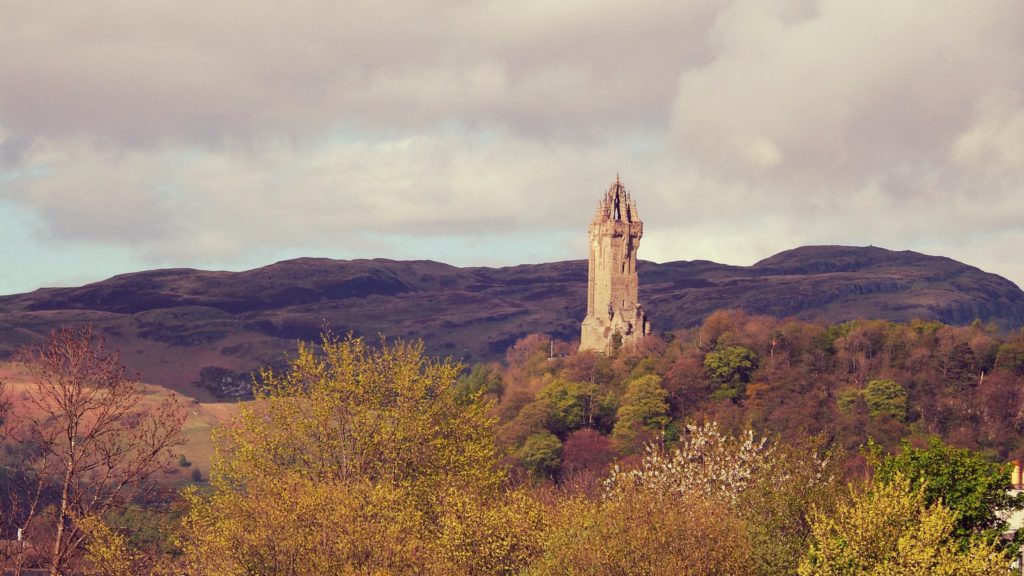
…the most beautiful scenery as we looked across at the Ochil Hills with the play of sunshine and cloud shadows upon them. We could see Wallace’s Monument, in which is his sword, commemorating the Battle of Bannockburn.
Returning to The Ridge late, on April 11th 1962, after playing Badminton, Gran is surprised to find Jane there. Excitedly, she writes, “She had brought home her Wedding Gown, the loveliest, daintiest creation of Nottingham Lace in a design of roses”. And two days later, in Winchester with Jane, she purchases the material for her own dress.
The family gathers for Easter. Gran has made a Simnel Cake, and Jane and Stuart arrive at The Ridge late on April 19th.
“Just as we were finishing lunch, rather late”, Gran writes on the following day:
Barry, Julian and Ricky burst in upon us, a day earlier than expected but, happily we were able to find enough for them to eat, and afterwards all went down to Beaulieu Road, which proved a most enjoyable expedition.
There they hear their first Cuckoo of the Spring but I do not remember this so much as the entertaining but accidental reverse somersault off the top of a five-bar gate, which I performed, when Stuart, attempting to hurdle it, whacked it with his foot, knocking me off my perch!
Easter Day is April 22nd and after lunch, the New Forest is their destination again. Julian is anxious to see Rufus’ Stone but his Dad is keener, as Gran tells us, to find a particular moss:
After parking the cars, we walked along the valley in which were the trees on which Barry’s moss was said to grow. He was lucky, for following directions read in a report, he went straight to a certain Beech tree and found the moss Zygodon forsteri, which is one of the rarest mosses in Britain and only known from five Beech trees in the Rufus’ Stone area. It is dark green, with soft leaves and grows in the clefts down which moisture seeps.