Image Credit: Images created in Book Brush using Pixabay photos. AI images avoided.
I sometimes use random generators (and there are loads of them) to trigger ideas for stories. There are historical event generators which come up with what happened on a certain date in history to name just one example. There are random date generators too, separate to the historical ones.
Dates and Historical Fiction
Now one way to use a date in fiction would be to fictionalize the historical event. You could retell the event through the eyes of someone who would have been at the event but not the lead character in it.
For example, you could tell the story of someone who was allowed to watch the execution of Queen Anne Boleyn. But you would need to know when that happened and why your character could be allowed to be there given it was a private execution and not “open” to the public to see. (Yes, Henry VIII was worried about the public coming out in favour of Anne. If only he knew what so many of think of him now…!).
Another way would be to ask what if that historical event never happened. What would that date have become known for instead? There is a lot of fun to be had in writing “what if” stories and not just for those of a historical “bent”.
Dates and Science Fiction/Fantasy
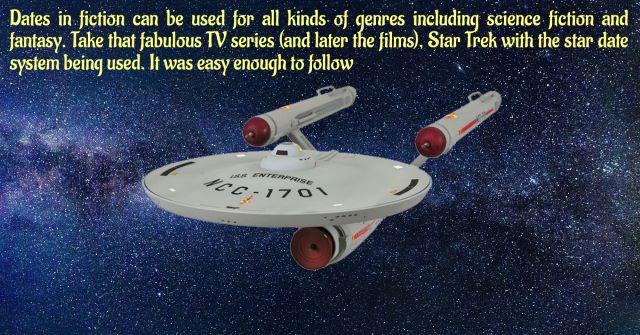
Dates in fiction can be used for all kinds of genres including science fiction and fantasy where the dating system may well not match our own. Take that fabulous TV series (and later the films), Star Trek with the star date system being used. It was easy enough to follow.
Indeed by setting an invented date, you flag up immediately to a reader something of what your setting is likely to be. Hopefully they will then read on to find out (a) if they’re right and (b) to find out what happens because it is clear from the invented date this world is something we don’t know so what does happen here? Is it something we can relate to despite the strange (to us but not to your characters) setting?
What Dates Mean To Your Characters
You can also use dates to help bring your characters to life. For one thing, they may well be going on a date. What are they hoping will come from it? Friendship or more? Also what would specific dates mean to your characters and how do they honour them? Plenty of story ideas to come from that.
Also you could think about what one date would mean to more than one character in your tale. If you’re thinking about anniversaries, would one character look forward to the date coming around and the other dread it? Good ideas to explore there.
Meaningful dates, regardless of what your characters make of them, help bring your creations to life. We all have dates which mean something special to us, for good or sad reasons. It strikes me as odd that characters wouldn’t have something similar. Certainly this is something a writer could usefully exploit.
Using Dates to Help Create Settings
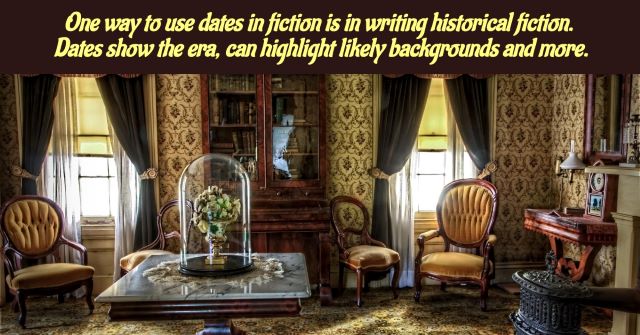
Naturally you can use dates in your story to help conjure up eras for your readers and not just for historical fiction though that is perhaps the obvious use for this. If your crime story is set in London in the Swinging Sixties, that will tell your readers a great deal about what to expect.
You can also use specific details to give readers an idea of the likely date in your story without spelling it out in some other way. If your character wears mini-skirts, that will give a clear idea, especially if it is something which has not been seen in the area where your character lives before. That mean it is likely to be the Sixties your character is living in.
Time Frames
A story is a contained unit with its own time frame. Many of my flash stories take place in short time periods. Some take place over a day or more. Sometimes when I’m writing historical flash, I will name a certain date within the story because those who know the date will have a better sense of the story setting. The story will expand so those for whom the date didn’t resonate will still get plenty from the tale.
Dates are useful details. They help place your characters in time (and to me that makes even the most fantastical of stories more likely to be believable. I believe this is a case of thinking along the lines if this world could somehow exist, they would have to have some way to measure time and the characters would be in that era).
Time/Dates as a Plot Device
I’ve written stories where someone tries to cheat Time or where Time is shown to be a character in their own right. Sir Terry Pratchett did this in the longer form with his Thief of Time novel, one of the Death books in his Discworld series. Well worth checking out.
Crime stories also often need characters to meet timelines. It’s no good having your character planning to rob a bank, say, with another character, and they get their dates mixed up (though it could be a good humorous tale).
Dates For the Writer
I suppose because I enter various short story/flash fiction competitions, dates do have resonance with me. I’m always trying to meet deadline dates too. So to me it makes sense to bring them into fiction too.
Characters have their obligations within their story setting too. Characters have to seem as if they could be real to a reader so having your creations being “answerable” to dates and times makes sense. I will have every sympathy for a character who is trying to get an urgent report in by a certain date and time, partly because I’ve been there (!), but also it is something which readers can identify with. It makes the character seem more real to me.
Conclusion
However you use dates in your fiction, I think these can be one of those telling details which help give a story a solid foundation. Readers know it is all made up, of course, but there have to be elements of truth within the tales, otherwise they’d be too outlandish to read, I think. So having a character set in a specific time/date frame does make a great deal of sense.
Related Posts:-
Read interviews with Chandler’s Ford writer Allison Symes: Part 1 and Part 2.
Read blog posts by Allison Symes published on Chandler’s Ford Today.
Never miss out on another blog post. Subscribe here:






Leave a Reply