My Mother’s Diaries: Summer Holidays and Harvest at Hiltonbury
Life on the farm in July and August 1951
By Andy Vining
A picnic in the fields, twenty-four pounds of cherries to bottle, school sports and a harvest repeatedly interrupted by rain: summer at Hiltonbury Farm in 1951 was anything but idle.
My mother’s diaries bring together two sides of our family life. There were outings, visitors and children enjoying their holidays, alongside the daily responsibilities of a working farm. Sometimes the entries are amusing; sometimes they record sadness in just a few words.
These were also years before electricity reached Hiltonbury. Washing, ironing, cooking and preserving food required considerable work, yet Mother still found time for gardening, teaching dancing and keeping her diary.

A quiet house, and a field full of cricketers
July began with an unfamiliar feeling: the farmhouse seemed quiet.
Janet was out with the Deans, and Father, John, had left for Cambridge with Norman. Mother carried on with the washing and ironing while friends called for tea and supper. Father telephoned from Cambridge, but his return soon brought him back to gathering hay at Flexford.
There was an unusual incident when Joan and Lorna brought their dogs over for a walk. Mother recorded that the dogs somehow got merry on cider. Quite how that happened is not explained!
By the end of the week, the hay at Flexford was finished. The family watched the Kings Road Sports on the cricket field, played tennis at Chalks and welcomed the Beetons and Deans for a cup of tea.
One particularly happy day brought me home from St Probus School with two school friends. Father collected us, we had a picnic in the field, and the Deans came up to play cricket.
That evening, we were driven back to Salisbury. For me, those visits home were a chance to return to the farm and family life I loved.

Success at sports day
Our school sports day brought another journey to St Probus, although the car was running badly and my parents arrived late.
Fortunately, they were in time to see me win the wheelbarrow race. Mother and Father then entered the parents’ race—and won that as well. It was a successful afternoon for the Vining family!
The summer offered plenty of other entertainment. Mother went to Highcliffe with the Deans, but it was too chilly for the beach, so they had tea in the forest instead. Later, they visited Fleming Park, where Father’s Uncle Ern was playing in the band.
Jennifer, Janet and Heather were taken to the circus, while Mother enjoyed a rather different outing to London with the Deans and Bunty.
Their visit included the Ford works at Dagenham, a journey on the Thames and a meeting with Bob at the factory. Afterwards, they went to the Empress Hall to see London Melody. It made a memorable change from the familiar round of farmhouse work.
A kitchen full of summer fruit
Back at Hiltonbury, the garden was producing food faster than it could be eaten.
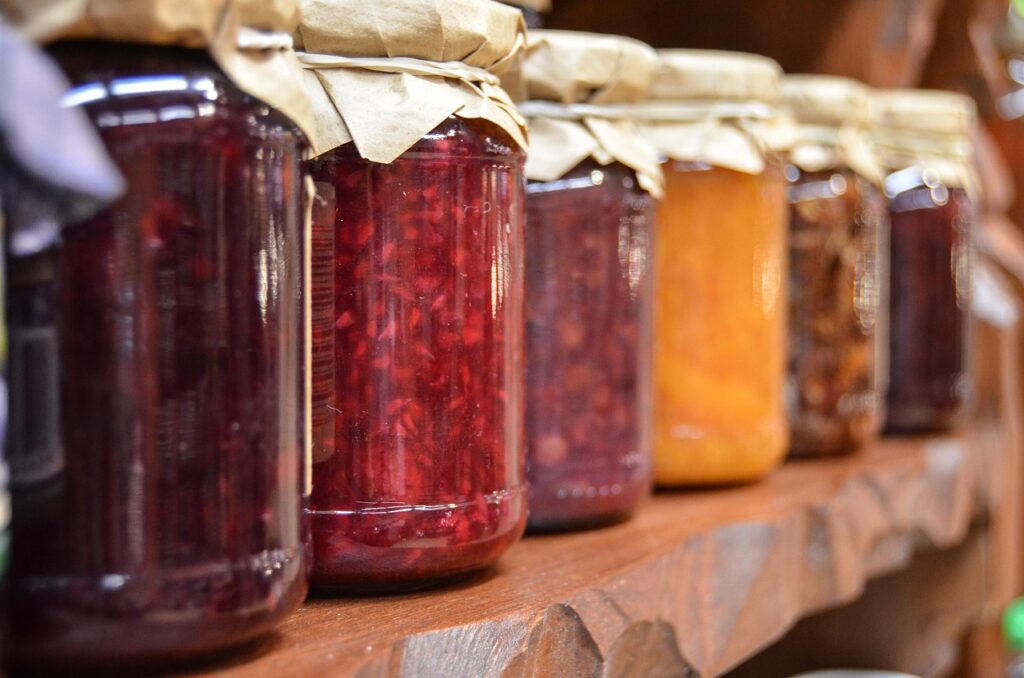
Mother made eight pounds of raspberry jam and picked four buckets of peas. On another day, she collected twenty-four pounds of cherries from Bazeley’s and bottled them that afternoon.
Without a refrigerator, preserving the summer’s produce was an essential household task. Raspberries, blackcurrants, cherries and vegetables all demanded attention while they were ready.
Yet the kitchen was also a place of hospitality. An American supper brought together the Deans, Parkers, Beetons, Bob and Bunty, and Bet and Fred, with everyone contributing food.
There were quieter moments, too. Mother and Heather had tea on the front lawn while Bob and his family picked peas.
The heat eventually broke in a tremendous thunderstorm. Mother recorded that the duck pond filled completely in only two hours.
Farm machinery provided another interruption when the milking machine went wrong. Whatever else was happening, the cows still needed milking, so getting it working again was a priority.
A new Jersey heifer
Towards the end of July, Mother went to the Lyndhurst Show. Another early start took my parents to a Jersey sale at Salisbury, where Father bought a heifer.
The Jersey herd was central to Hiltonbury’s working life, and a new animal was an investment in its future.
After the sale, they collected me from school and bought me new clothes at Whalley’s. By then, Father had begun cutting the first oats at Flexford, and the summer holidays were arriving just as harvest work gathered pace.
There was still time for a picnic with the Coates, Julie Richards and the Bazeley girls, although another evening storm reminded everyone how uncertain the weather could be.
Holidays, horses and a sharp observation
August began with visits to see roses at Hillier’s and Rogers, followed by gardening and painting the front windows.
The children were given a practical job: mucking out the stable. Mother’s verdict was brief:
“They smell!”
Whether she meant the children or the stables remains open to question.
Jennifer went to the Hursley Hunt Gymkhana at Romsey, where rain spoiled much of the afternoon. Soon afterwards, her clothes and belongings had to be prepared for Pony Club Camp at Hursley Park.
Father, Mother, Janet and I also visited Shaftesbury Market with the Dunfords. Mother enjoyed the outing and thought it a lovely spot.
But these weeks brought family sadness. Auntie Ag became seriously ill and died while at Hursley. Her death sits among the ordinary entries, one of those moments when the diary’s busy rhythm pauses.
The loss of Emblem
There was sadness on the farm as well.
One of our cows, Emblem, gave birth to a heifer calf, but then developed milk fever. The vet was called, and when she failed to improve, he returned.
On Monday morning, Bill Wren, our cowman, found her dead.
The diary records the practical consequences as well as the loss. Her calf needed care, and Mother and Father took it to Winchester; it was later taken to Hursley to be fed and looked after.
A cow’s death was a loss to the business, but the diaries also remind us that these were individual animals, known by name. Emblem’s story remains part of the farm’s history because Mother wrote it down.
The work could not stop. That same day, Father cut oats in the Factory Field.
Later in August, another cow, Cantley Romany, produced a heifer calf. On a smaller scale, Mother also noted the first egg from one of the new hens. Such milestones mattered enough to earn their place beside the larger events.

Harvest between the showers
Through August, Father worked on oats, rye and wheat, cutting, threshing and carting whenever conditions allowed.
Mother helped pick up oats at Flexford. Friends and family sometimes walked over to see the harvest field, while the men made use of dry spells and worked into the evening.
Rain repeatedly interrupted progress. Even a fine day did not necessarily mean harvesting could begin if the ground was still too wet.
Meanwhile, Mother painted bedroom windows, dealt with the washing Jennifer brought home from camp and continued feeding visitors.
When tennis was impossible, the family played table tennis with the Deans instead. Les repaired the harrows during one showery Sunday visit.
There were worries beyond the weather. Four cows failed the TT test, an unwelcome entry concerning the herd’s tuberculosis testing.
Wasps were another nuisance. Two nests were destroyed, but Janet still suffered a sting on her bottom—an incident that apparently attracted more amusement than sympathy from the other children.

A rainy-day trip to Wonderland
On one thoroughly wet day, Mother took our children, Carol and Richard to see Walt Disney’s new film, Alice in Wonderland.
They queued for an hour, but the film was judged a success. For the children, it offered an escape from the rain; for Mother, it was another outing fitted around the demands of home and farm.
Near the end of August, she toured the locomotive works with Crossie and found it “jolly interesting”, despite yet more rain.
The month closed with Joan coming to tea, a walk at Flexford and Cross and Den taking the children to see a farm at Eastleigh.
Looking back, it was a summer rich in ordinary experiences: cricket, picnics, horses, cinema visits, jam-making and friends around the table. Alongside them were unreliable machinery, difficult weather and the loss of people and animals.
Mother did not write a grand history of Hiltonbury. She recorded what happened each day. Seventy-five years later, those small details allow us to step back into a farming summer and hear something of the family life that surrounded it.

My Mother’s Diaries – The Hiltonbury Farming Family Story 1948–1976 is a weekly podcast drawn from my mother’s diaries and my own memories. Discover more and listen at mymothersdiaries.co.uk.
Related posts:
 History of Hiltonbury Farmhouse
 Andy Vining’s Podcast: My Mother’s Diaries 1948 – 1976: Episode 8 — January and February 1949
Andy Vining’s Podcast: My Mother’s Diaries 1948 – 1976: Episode 11 — July and August 1949
Andy Vining’s Podcast: My Mother’s Diaries 1948 – 1976: Episode 14 — January and February 1950
Andy Vining’s Podcast: My Mother’s Diaries 1948 – 1976: Episode 16 — May and June 1950

Leave a Reply