Image Credits:-
Images created in Book Brush using Pixabay photos. Screenshots were taken by me, Allison Symes. AI images avoided.
Over the years, I’ve collected a number of excellent books on the craft of writing. I still refer to many of them. The ones I tend not to refer to much are those where I thought I might go down a particular path in writing but have not gone on to do so. I’m loathe to ditch these books, simply because I know how writing journeys can change and it’s not impossible I might come back to these things later.
All of these books, along with going to writing events and learning from courses/workshops, discussing the writing life with other authors and so on have done so much to help my continuing professional development. I’m sure they’ll continue to do so too.
I thought it would be useful to share some tips on what I look for in a potential writing guide to add to my shelves and I hope you find these useful.
Tips – What Is The Right Guide For You?
1. Before I head to a bookshop, I will already know a fair bit as to what I’m looking for in my next guide. Will it be something to help me with my genre, navigating the writing life in general, how to improve my chances at writing competitions, and so on. Narrowing down your field of search is crucial. There are loads of writing guides out there but the important thing has to be what do you need in your writing life as a guide right now or what you believe you will need in the short to medium term.
2. You also need to work out the level you want from your potential new writing guide once you’ve got past the beginner’s stage. Which guide will help you progress further? Which is too far for you at the moment but is something to aim for? I do think you need something like a beginner’s, an intermediary’s, and a highly experienced coding system for writing guides. Despite their name, I do have a soft spot for the For Dummies series. I like the layouts used in this series. The information is clear and concise. My favourite one here is the Scrivener for Dummies one, which I have found so useful as I have got to grips with the Scrivener program.
3. There is a case for looking ahead a little to where you think you might want to be. When I turned to the short fiction form, my first guides were on the craft of writing short stories. It was only later when I was beginning to get into flash fiction, I looked for guides on that topic. But you may well know where you want your writing to head eventually and that can give you a head start here. See point 1 too.
4. I always check out the guide’s author’s credentials as a general rule but I did make one exception here. I did take the credentials as read for Stephen King when I picked up his On Writing guide which is both memoir and a great writing advice book. I highly recommend it. But checking out the author’s credentials generally is a good idea. I want guides from those who have been working in the respective writing fields for a while.
5. Recommendations from writing friends are fabulous because they will tell you why they found the guide useful. That is wonderful information to have to hand. Experienced writers know what they’re looking for from these things so will not waste your time, or theirs, on any guides which are not up to the mark. I always take recommendations from writing friends seriously here.
What Do You Want From A Guide?
I like to see clear tips, followed by worked examples, and ideally there would be exercises for me to have a go at having read the chapter(s) concerned. Seeing how something is done and an explanation of the worked examples is, for me, the best way of learning. I am then more confident to at least give the exercise a go after that.
Understanding why a tip works and how to make the most of it for my own writing is incredibly useful too.
I also have a soft spot for those guides which leave pages for you to write in. It makes the guide more personal for me. I know. I normally wouldn’t dream of writing in a book unless I’m signing a copy of one of mine for someone but writing guides are different here. I think the fact the page is there precisely so you can use it directly is a great encouragement to actually get on and use it.
I don’t mind if the guide is a one-off or part of a series. I’ve used (and continue to use) plenty of both in my time. I also suspect I’ll pick up a guide or two from the Book Room at this year’s The Writers’ Summer School, Swanwick.
The Purpose of a Good Writing Guide
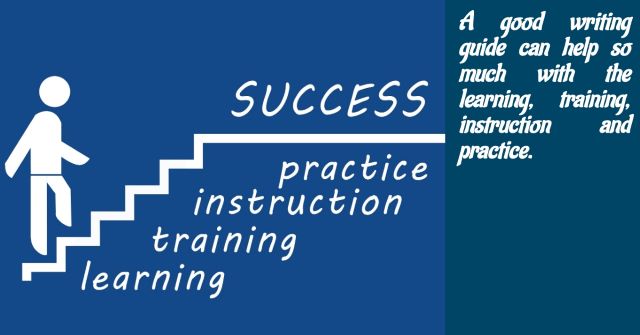
All good writing guides should encourage you to get on and write and help you see yes, this is an avenue I can explore further to develop my own writing. A good guide should give you an invaluable starting point, your way in if you like.
The ranges available are immense. I’m always interested in creating characters so guides on that aspect I can always find a home for. I’m not interested in screenwriting so will give those a miss. It pays too to be honest with yourself about where you think your writing could do with work to improve it. If you know plot is a weakness, there are plenty of plot guides out there.
There are always aspects to the writing life/getting into the industry to learn more about. When I started writing seriously for publication, practically all submissions had to be made by post. Not now! Email or forms such as Duotrope, Submittable etc are the norm. But the advice on how to lay out your work ahead of submitting anything still holds good.
Conclusion
Don’t forget you can borrow many of the writing guides from the library. This is especially useful if you know roughly what you are seeking but need to hone the search down more. You will then know what is worth you buying and keeping and what is best just borrowed.
The Writers’ and Artists’ Yearbook can often be borrowed. As well as its listings, there are articles in there which could prove useful.
Everyone is new to the industry at some point. A good guide can give you excellent pointers as to your next steps and can save you a great deal of time in seeking out what you need to know/would be useful for you to know.
Related Posts:-
Read interviews with Chandler’s Ford writer Allison Symes: Part 1 and Part 2.
Read blog posts by Allison Symes published on Chandler’s Ford Today.
Never miss out on another blog post. Subscribe here:




Leave a Reply