Image Credits:- Images created in Book Brush using Pixabay photos. AI images avoided. Screenshots taken by me, Allison Symes.
Deadlines are a fact of the writing life and apply equally to non-fiction as well as stories of all lengths.
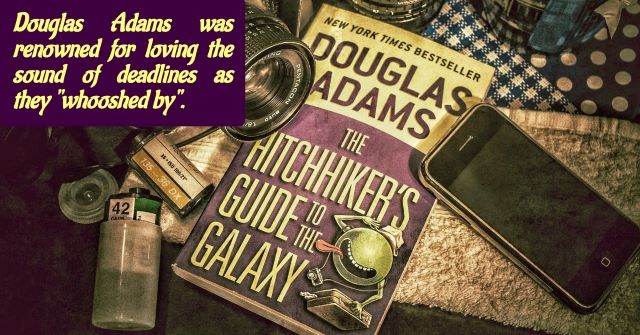
Douglas Adams, renowned for his The Hitchhiker’s Guide to the Galaxy series, famously said he loved the sound deadlines made as they “whooshed by”. Hmm… I do feel sorry for his editor and publisher here. Someone has to meet printing schedules etc. Clearly, Douglas Adams left that for someone else to worry about!
Having said that, you would get short shrift if you tried that now. You would have to be a very big name indeed to get away with that and I’m not convinced even by that. There is a greater awareness of how the book market works. Everyone wants their books out in time for the Christmas market and, for certain books, the summer holiday one. You definitely have to meet deadlines to have any chance of achieving this.
Deadlines are one of those things, along with editing, which writers either grimace at or just accept and don’t worry about.
That said, I think there are ways to handle deadlines to make them more manageable. It is also not a bad thing to get used to them. If you’re writing novels, novellas etc., publishers and/or agents will want your work in by a certain time. You in turn will also want them to get your work out there at any time agreed in your contracts. For the short form writers, where we’re often submitting work to competitions, again we have to meet the deadlines if we want our stories to be considered.
With my non-fiction hat on, I have deadlines for Chandler’s Ford Today and Writers’ Narrative, plus I blog for Authors Electric and More Than Writers, the blog spot of the Association of Christian Writers (ACW). I’ve found with CFT having a weekly Friday deadline makes it easier for me to market my posts when I share them online. It also makes it easier for me to schedule in author interviews. With ACW, I also run a monthly flash fiction workshop and again I have to have material ready for the dates of the meetings.
I think deadlines are a good thing. They encourage productivity. As well as meeting a deadline for one project, once that’s done, you can get on with the next one and so on. Also, the more you’re used to them, the better you get at finding ways to handle them.
Tips for Managing Deadlines
I think it helps to see deadlines as a spur to get work finished and “out there”. This is why I see them as an aid, rather than something to be anxious about or annoyed by. So I hope you find the following thoughts useful.
1. I use a diary to mark down when deadlines are. Just doing that keeps me on track. I refer to the diary at the start of any writing session to ensure I haven’t missed anything.
2. For competitions I take about a week or so off the official deadline and use this date as my final deadline. It means I always get entries submitted in good time. But it also gives me time to do any final tweaks and pick up on errors which have somehow made it through my editing rounds. It happens and to every writer too so it pays to be aware of this and give yourself time to specifically look for these. It makes it more likely I will spot something too.
3. Doing the above means I can schedule in when to have my first draft and main edits done by. I find this incredibly helpful because it takes the pressure off. I know I’ve got the time to do what needs to be done. It also allows for those times when life gets in the way. I can adjust my self set schedule to accommodate this.
4. For editing work, which takes significant time, I tend to work out where I’d like to get to by the end of each week. That helps. Nobody can edit all in one go so breaking the task down into manageable chunks makes a great deal of sense.
5. I guess all of this feeds into my love of planning. No two writers or editors go about their work in exactly the same way but some forward planning is the only way I know to ensure deadlines don’t go “whooshing by” for me.
Old School Ways
It is perhaps an oddity of mine I find writing deadline dates down in an old school diary more effective than putting these dates on my phone.
I suppose that may be I find I can ignore the phone. I never ignore my diary! I think there is a subconscious level of accountability to myself going on when I physically write things down.
In general terms, meeting deadlines consistently is a professional thing to do and the sooner you can used to meeting them, in the ways which suit you best, the better. You will end up writing more too.
Deadlines also make you get work out there at all. It can be easy to sit on work and keep tweaking it and keep tweaking it forever and ever, amen. At some point you need to test the market with the piece if you want to be published. I’ve found a deadline makes me get on and submit work then. Then, naturally, I get on with the next piece and so on.
Conclusion
Over the last few months, deadlines have been top of my agenda for two great reasons. Firstly, I’ve been editing books for a client. Secondly, I’ve been working on my own third book, Seeing The Other Side, and now know the publication date for that is 18th June 2026.
Deadlines can help you achieve things. Put like that, maybe they’re not so bad after all.
Related Posts:-
Read interviews with Chandler’s Ford writer Allison Symes: Part 1 and Part 2.
Read blog posts by Allison Symes published on Chandler’s Ford Today.
Never miss out on another blog post. Subscribe here:


Leave a Reply