Image Credits: Images created in Book Brush using Pixabay photos. AI images avoided.
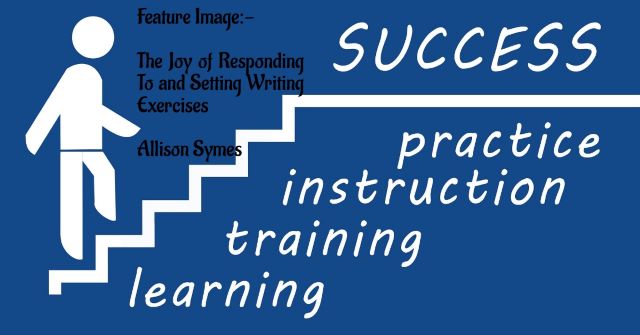
Writing exercises are a major part of my writing life. There are several reasons for this.
What I produce as a result of the writing exercise is more work I can polish up and eventually submit somewhere. I’ve had work published thanks to doing this.
Exercises got me used to the idea of being a “proper writer” as I was responding to a prompt set by someone else. They’re excellent workouts for the brain. They’re also good practice for writing to competitions with a set theme.
Most exercises I’ve been set are at events, day trips, online ones, or The Writers’ Summer School, Swanwick. These are a natural part of the writing life and the whole idea is to get you writing more than you would have done alone and to tackle themes you might not have thought of trying.
My Favourite Writing Exercises
I use (and have been set) a wide variety of writing exercises but most writers will find there are a few they come back to time and again. I especially love:-
Opening lines.
Closing lines.
Where you have to use certain words in a story – sometimes in the order they were given to you, at other times as you want them to be placed.
A limited word count exercise – this is right up my writing street, as you can imagine.
A name, a situation but the rest is up to you.
Picture/object prompts – I find these are open to many interpretations.
Set theme. I write down what could come from that theme. There are usually plenty of ideas and directions to come from doing that.
All dialogue stories – these work best when kept short. I often write flash pieces like this.
Using the senses.
Question prompts – your story has to answer this. It’s a great challenge.
Tips for Writing Exercises
I’ve always found it useful to know something about my potential “character star” first but this is almost certainly due to my belief the character makes the story. For me, a story works or not, depending on whether I believe in the character or not. As long as there is something I can identify with in the character, no matter how fantastical they are, I will believe in them. It’s why I’ve not found writing from the viewpoint of a mother dragon to be problematic because I’ve understood the reasons for their actions. I don’t have to agree with them though!
So I work out roughly who my character is going to be/will have to be due to the nature of the exercise set. If the exercise is set on the theme of honesty, for example, I can decide whether to get my character to show they are honest or to be the opposite. Both show up the theme.
So it pays to work out how you are going to “play” the exercise you’ve been set.
Now there’s always an exception to any rule and there is here too. If you’re at an event, you’ve got no idea of what is about to be set, then you do just have to freewrite whatever comes into your head to write. That is the idea of this kind of exercise.
Freewriting can be amazing for what it reveals when you have the time to go through your notes later. A good thought here, especially when a theme hasn’t been set, is to pick a favourite topic of yours and go with that. You’re more likely to come up with something.
If a theme has been set, what you’ve been listening to/discussing in the event should be throwing up some clues. For example, if your event is focusing on writing crime stories, and you are set an exercise to write the opening couple of paragraphs to a crime story, then the speaker will already have given you some thoughts on to how they write their tales here and tips on what they’ve found useful. You’re at that event, in the first place, to learn this.
Also your own love of crime stories, what you like to see here, will come into play here and help you draft something. Nobody drafts what they wouldn’t like reading. It’s yet another reason to read well because you will have those stories you love to draw on for inspiration. Nobody is going to reinvent the wheel here.
Remember the idea isn’t for perfection. The idea is just to get something down you can improve on later. So do just write.
Practising writing for competitions with or without themes will help you get used to doing this, even if you never send your stories in (though I would hope you would after editing etc, you’ve got to be in it to have any chance of winning it after all).
Focus on just getting something down. I find it helps to see editing as a separate, and different, creative task, but without something down on the page/on the screen, there is nothing to edit.
Practice writing to various exercises so you (a) get used to them and (b) discover the ones you like best. Books of prompts are useful here because they tend to mix up the kind of exercise they set you.
Setting Writing Exercises
I lead a monthly flash fiction group for the Association of Christian Writers. I set exercises according to topic.
A recent theme was “five” so I set five opening lines, five closing lines, and five ways to use the number five in stories for people to try. I sometimes draft an exercise to show on the night of the meeting. At other times, I join in with the exercises I’ve set on the night. It means I get some useful draft stories written too! All useful stuff.
Setting the exercises also means I have to think outside of the box. I want something which will be interesting, a challenge, but also something I know people can do. Writing exercises can help boost writing confidence. I recall being nervous at having a go at the first exercise I was set but I gave it a go. The more you do of these things, the better you get. That helps with confidence too!
Conclusion
Well, they say exercise is good for the body. Writing exercises are great for the creative mind. I like to keep things interesting in my writing life by deliberately having a go at different kinds of writing exercise (and the random generators are a fabulous help here. You’re never going to run out of these. Also, you can vary the parameters you set on them which gives you even more range).
Also there are so many writing exercises out there, it is lovely every now and then to try one which is new to you.
One of the stories in my new Seeing The Other Side started life as a writing exercise set at The Writers’ Summer School, Swanwick a few years ago. So a writing exercise can take on a new life of its own, once it has been honed, edited etc.
I hope whichever writing exercises you do, you enjoy them but also consider mixing up the types. I find responding to the challenge of these great fun to do and hope you will too.
Related Posts:-
Read interviews with Chandler’s Ford writer Allison Symes: Part 1 and Part 2.
Read blog posts by Allison Symes published on Chandler’s Ford Today.
Never miss out on another blog post. Subscribe here:


Leave a Reply