Introduction
Hello, I am fairly new to the blog, so I ought to introduce myself and explain my connection to Chandler’s Ford. I arrived here in 1973, as a student, having hitchhiked my way from Swansea, heading for Southampton University where I had been offered a place to read for my PhD.
In those days hitchhiking was a popular means of transport for young people, although it is rarely seen today. The kind person who gave me a lift for the final stretch from Newbury, dropped me off in Chandler’s Ford at the junction where Leigh Road meets Bournemouth Road and I was pointed towards the bus stop where I could make it by public transport for the next few miles. However, I had a look at Chandler’s Ford, took a walk up Fryern Hill and saw an advert for a bungalow to let. I must have made an impression on the agent who offered me the property, and several weeks later my wife and I moved into our new surroundings. Later we bought a house in Chandler’s Ford and remained here until this day.

My studying and teaching
I completed my PhD in 1976 and sought an academic post in a period of austerity when the expansion of universities was coming to an end. To gain a foothold in my intended career I needed experience in teaching and a better background in research. I found teaching work in a variety of interesting places which included the Open University, Hospital Chaplains, HM Prisons in Winchester, Dartmoor, Kingston Prison in Portsmouth, Maidstone Prison, Broadmoor, and Albany and Parkhurst on the Isle of Wight. I then received an invitation to work as an instructor with US Naval Security for a year. Fortunately this did not involve swimming around the docks with a knife in my teeth, but it did lead to a number of adventures years later.
From the seventies until today I held academic posts far from Chandler’s Ford where I continued to live; I had posts in the universities of Kent, Manchester, Cambridge and Birmingham where I currently hold an honorary readership in Bioethics as an excuse for dodging retirement. Among my recent projects are the supervision of research on gender re-assignment surgery and the examination of research on bioprospecting in South Africa.
Training Newfoundland dogs in Chandler’s Ford
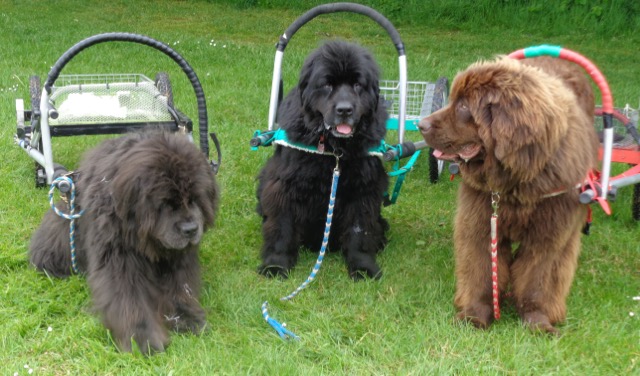
One of my leisure activities here in Chandler’s Ford involves training Newfoundland dogs, and I would like to devote a couple of articles on this subject in forthcoming blogs. These are large dogs weighing around 60 kilos when fully grown, with tremendous strength coupled with physical structures suitable for powerful swimming and draft work. I would like to discuss their water work at a later date, and focus here on their carting skills, beginning with brief history of dog carting .

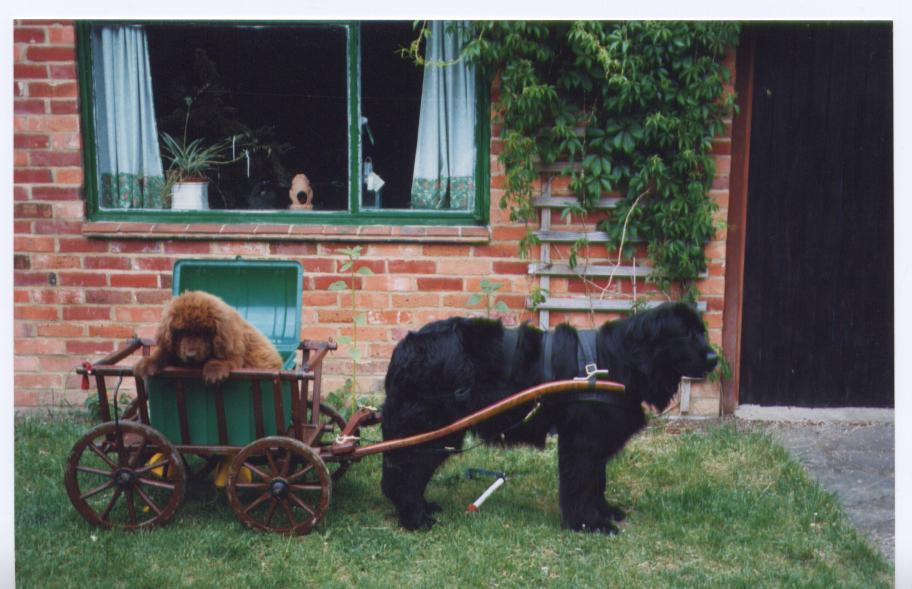
During the 18th and 19th centuries large dogs, such as the Bernese and Newfoundland, were used as draft animals, and traders would be seen delivering their wares in streets that were too narrow for horses. Relay teams of Newfoundland dogs would take fish from the port at Southampton to the markets in London. However, despite romanticism about the historic role of carting dogs many of the dogs were over-worked and cruelty was obvious so that the newly formed Society for the Prevention of Cruelty to Animals (later the RSPCA) together with various humanitarians sought to impose a ban on using dogs as beasts of burden.
Prohibition of dog carts
In the mid-19th century laws were passed prohibiting dog carts on the public highways. These laws were not about road safety as this was before the motor car was invented; they were about perceived cruelty, which the RSPCA described as ‘cruel servitude’. Although attempts are nowadays made to replicate the carting activities of dogs there is, fortunately, no return to the training methods which were assisted with a whip.
The use of dog-carts in England was ended by piecemeal legislation. In 1839 a clause in the Metropolitan Police Act denied the use of dogs as beasts of burden within 15 miles of Charing Cross. This alone resulted in the destruction of more than 3,000 dogs. A more general Bill was introduced into Parliament in 1841, to ban the use of dog-carts throughout the kingdom.
When an anti-dog carting Bill was being introduced in 1854, the Earl of Malmesbury stated that in Hampshire and Sussex alone there were 1,500 people earning a living from dog-carts. Cruelty was widespread. Dogs would be fed to other dogs. In the debate on the 1841 Bill, Lord Brougham spoke of a dog-cart driver who had ripped up an exhausted dog and given its entrails to two other dogs for food. The Earl of Eglington, opposing the Bill, forecast the destruction of between 20,000 and 30,000 dogs.
The slaughter of thousands of dogs
The reaction of traders to the prohibition of carting dogs on the public highways led to the slaughter of thousands of dogs and their carcasses were thrown into the streets, causing health problems. To give an example, the Chief Constable of Cambridge declared a state of emergency until all the carcasses were removed to a bonfire outside of the city.
Throughout the 20th century the ban on carting dogs on the public highways remained and enthusiasts would carry out their activities on private land. Breed societies devised tests which were designed to maintain the function of several large breeds as draft dogs.
The Animal Welfare Act 2006
In 2006 the Animal Welfare Act was passed. I had a minor role in this legislation which repealed all prohibitions of carting dogs on the public highway. Subject to traffic regulations – for example, carts would not be allowed on motorways – dog carting on the highway was permissible. The Act was based on animal welfare which is determined by the Five Freedoms: 1. freedom from hunger and thirst, 2. freedom from discomfort, 3.freedom from pain, injury or disease, 4. freedom to express normal behaviour and 5. freedom from fear and distress.
Welfare considerations are applicable equally to public and private land, in fields or on the highway, and require that the animal’s welfare is neither compromised by act nor omission which will contribute to unnecessary suffering. It was not necessary to maintain laws prohibiting dog-carts on the highway as it is sufficient to recognise that many roads present a welfare risk to dogs.

The Animal Welfare Act 2006 was a milestone in animal legislation and Margaret Beckett, the Minister who supported the Bill, rightly deserves a place in history for her management of cross party support. MPs and Lords from both sides of the House cooperated in producing a well thought out piece of legislation. The Act was based on the requirement to eliminate unnecessary suffering – a utilitarian concept – rather than on animal rights – and its ethical status is consequential not deontological. That is to say, it is not based on the rights of animals and our duties to maintain these rights but is based on consequences by act or omission which leads to suffering.
The concept of animal abuse
In politics one has to accept that not all of your proposals will be accepted. I would have liked to see an inclusion of the concept of animal abuse rather than unnecessary suffering on which the Act is based. A well founded definition of animal abuse would have brought laws regarding animals closer to laws regarding humans such that parallels with child abuse, for example, could be drawn with abuse of animals. Laws on animal welfare are based on utilitarian principles, seeking to minimise suffering.
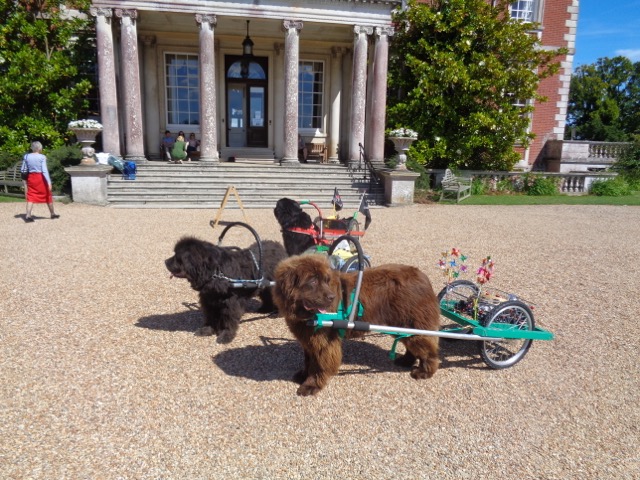
For obvious safety and welfare reasons dog carting on our busy roads is inadvisable and counter to traffic regulations. But under appropriate conditions dogs are permitted to pull their carts in public places. In many towns and villages throughout the country proud owners of large dogs may be seen in shopping centres with decorated carts – especially at Christmas time – raising funds for various charities.
All of my Newfoundland dogs have been taught to pull carts, although I have not attempted to recreate their past history but rather experiment with what I call ‘ freestyle carting’ where the dog completes part or all of an exercise several feet away from the handler. As I see it, the main objective is to build up the dog’s self-confidence where being attached to a carting apparatus is neither scary nor intimidating.
Here in the video is a link to an example of free style carting. The dogs understand the exercise, whether it is a manoeuvre or retrieve of an object, and simply get on with the task without repeated commands or direction from the handler.
Monty and Blue Freestyle Carting
We frequently perform carting demonstrations for the public at venues throughout the country, which gives the public an opportunity to meet our dogs. Earlier this year we gave our annual display at the Fawley Church Fete, a run off with Leonberger carting dogs at East Dean Manor, a display at Stansted Park at Havant, and our Grey Newfoundland, named Blue, won the carting competition at the National Newfoundland Dog Trials, and was also awarded for the fourth year, the prestigious Ashness Trophy for the best working Newfoundland in the country.
Some of us in the area belong to a group which can put as many as a dozen dogs with decorated carts into an arena at local shows and events. Already bookings for next year include a display at the Paws in the Park event at the Ardingly Showground in Sussex, and a display at an International dog event to be held at Rother Valley in the North of England.
One of our most prestigious performances involved our dog, Teddy, who provided a carting display in the main arena at Crufts several years ago. The audience warmed to Teddy despite an embarrassing moment as he was waiting in the wings. To add to the entertainment the Kennel Club had arranged for a popular entertainer to sing a solo piece which she did to perfection. Unfortunately when she hit the high notes Teddy decided to accompany her with very noisy howls. The singer took this interruption in her stride, and we laughed about the incident later. As they say in show business, never perform with children or animals.
Teddy Carting in the Main Arena at Crufts



Interesting post.
How many Horse Power is and dog?
Do you use them in teams, like Huskies?
Thanks Mike for responding. Not sure of the horse power, but it is estimated that a 60 kilo Newfoundland can pull 8 times it own weight. Perhaps their strength can be seen in water, where one dog can tow about 20 or so people or tow a boat with 6 people aboard – more on this in a later post. As for working in teams like Huskies I do not have the equipment, but in the US they are used in similar teams and there are accounts of teams of them pulling heavy weights in Alaska.